Find the right local tip before you load the car
A household waste recycling centre can help with furniture, electricals, garden waste, scrap metal, oils, paints and DIY waste, but the exact rules are controlled by your local council.
This guide gives you the correct official route first, then the practical checks that stop wasted journeys: booking, proof of address, van permits, DIY limits, hazardous items and legal waste carriers.
Fast route: what should you click first?
Do not start with a random “tip near me” result. Start with your exact local council, because council boundaries, bookings, van rules, trailer rules and accepted items can change street by street.
I just need my nearest recycling centre
- Open the GOV.UK local council finder.
- Enter the postcode for the property where the waste came from.
- Open your council website from the result.
- Search that council website for “HWRC,” “recycling centre,” “tip” or “household waste.”
I have a sofa, fridge, mattress or bulky item
- Check council bulky collection first.
- Check reuse or charity collection if the item is still usable.
- Check if your HWRC accepts the item and whether a booking is needed.
- For electrical replacements, ask the retailer about take-back.
I have chemicals, batteries, paint or asbestos
- Do not put hazardous items in normal rubbish.
- Use the official hazardous-waste service where available.
- Check your council’s item-specific rule before moving the item.
- Keep batteries, vapes and electricals separate from black bags.
I am hiring a skip or man-and-van
- Check the company is a registered waste carrier.
- Ask where your waste will be taken.
- Keep screenshots, invoices and messages.
- Do not use cheap anonymous collectors with no registration.
60-second route checker
This tool does not replace your council page. It tells you which official route to check first, based on the waste type, vehicle and UK nation.
Before you go: micro-checklist for any recycling centre
This is the page section that should save a real visitor time. Do these checks before loading, especially if you are using a new site, new vehicle or taking bulky/DIY items.
Find the correct council by postcode
Use the postcode for the property where the waste came from. Do not guess by the nearest town, because council boundaries can be different from postal towns.
Open the council recycling-centre page
Look for terms like “HWRC,” “household waste recycling centre,” “tip,” “recycling centre,” “A to Z of waste,” “vehicle permit” or “book a slot.”
Check whether booking is required
Some councils require slots for all visits. Others require booking only for vans, trailers, bulky waste or certain sites.
Check proof of address and ID
Many centres are for local residents only. You may need a driving licence, council tax bill, utility bill, resident permit or booking email.
Check your vehicle before hiring it
Vans, pickups, trailers, roof boxes and high vehicles may need permits or may be blocked by height barriers.
Search the exact item
Asbestos, plasterboard, tyres, gas bottles, liquid paint, mattresses, upholstered seating and soil often have special instructions.
Sort the load in unloading order
Keep reusable items, electricals, batteries, garden waste, metal, timber, rubble, cardboard and general waste separate.
What counts as household waste?
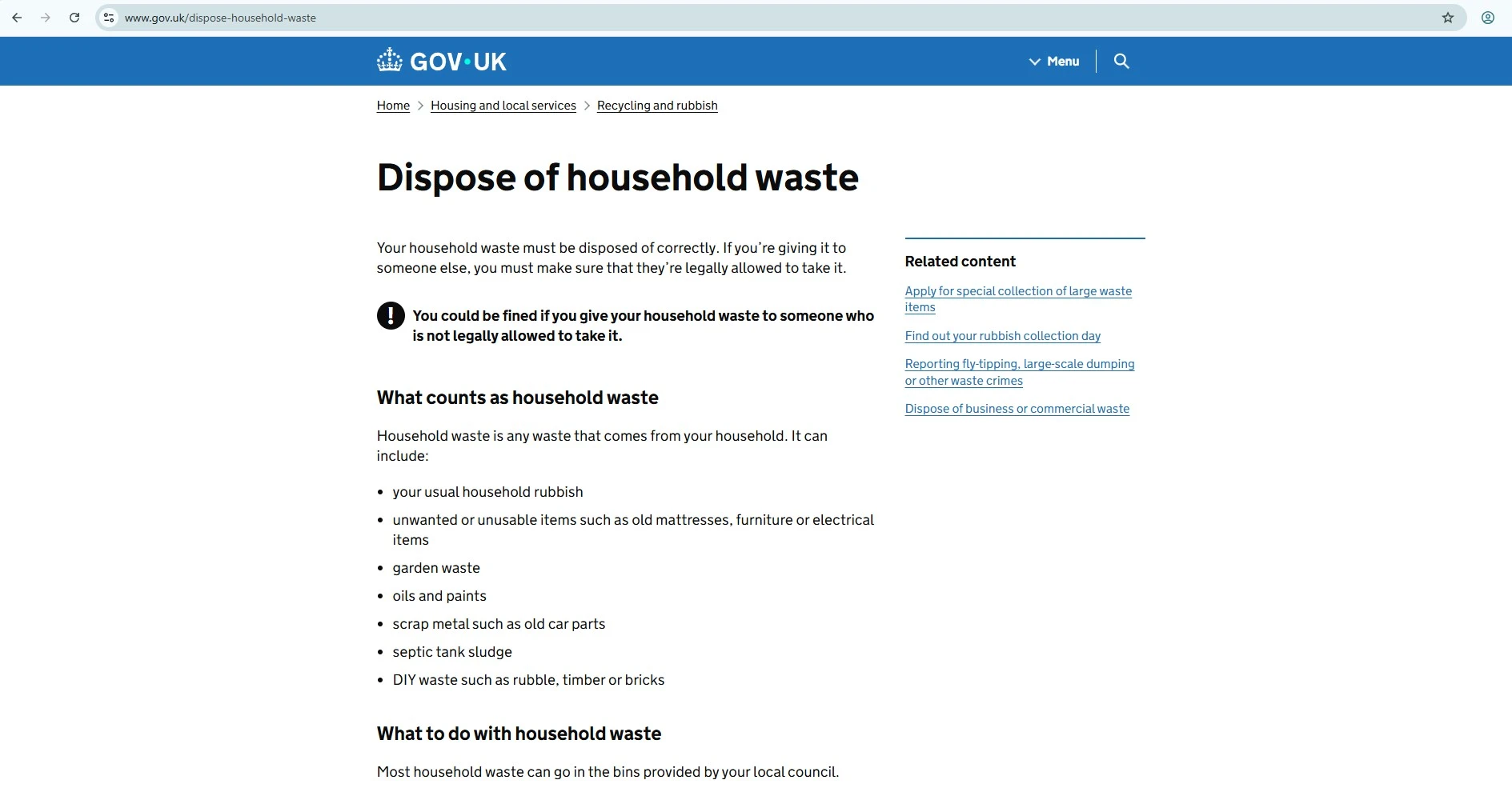
Household waste means waste from your household. GOV.UK examples include everyday rubbish, furniture, electrical items, garden waste, oils, paints, scrap metal and DIY waste such as rubble, timber and bricks.
Bulky household items
Sofas, mattresses, wardrobes, carpets, tables and fridges may be accepted at some centres, collected by the council, reused by charity or taken back by a retailer.
Electrical and battery items
Electricals should be kept separate from normal waste. Batteries and lithium-ion items can cause fires if crushed, hidden or damaged.
Garden waste
Garden waste may go to a council garden collection, home composting, or a recycling centre green-waste bay. Soil is usually not treated as garden waste.
DIY waste
Rubble, timber, bricks, soil, tiles and plasterboard are often restricted by quantity, booking, charge, vehicle type or dedicated container.
Booking, permits, proof of address and site access
Competitor pages often show only addresses and hours. The useful answer is what can stop the user at the gate. These are the checks that matter before leaving.
| Gate issue | Why it matters | What to check before leaving |
|---|---|---|
| Booking slot | Some councils require appointments or vehicle registration. | Council HWRC booking page and confirmation email. |
| Proof of address | Many centres are resident-only. | Accepted ID list: driving licence, council tax bill, utility bill or resident permit. |
| Van, pickup or trailer | Large or commercial-looking vehicles often need permits. | Vehicle permit page, vehicle length, trailer axle rule and visit allowance. |
| Height barrier | Roof boxes, high vans or tall loads can be refused or redirected. | Individual site access notes and height restriction. |
| Pedestrian/cyclist access | Many centres are vehicle-only for safety. | Walk-in policy before travelling without a car. |
DIY waste: rubble, timber, bricks, soil and plasterboard
DIY waste is a major user-intent gap. GOV.UK says household waste can include DIY waste, but waste from hired tradespeople, construction, renovation or business work is not the same as ordinary household waste.
Measure the load first
Councils may limit rubble by bag, tub, weight, number of visits, vehicle type or booking. Do not load a full van until you know the local rule.
Tradesperson waste is not your normal tip run
If a builder, plumber, bathroom fitter, gardener or contractor created the waste, ask them to include lawful disposal in the quote.
Keep renovation items separate
Tiles, plasterboard, wood, metal, rubble, sanitaryware, carpet and packaging can go to different areas. Mixed renovation waste is slower and more likely to be refused.
Stop if asbestos is possible
Do not cut, break, sand, drill or bag suspected asbestos like normal rubble. Use your council asbestos route or a licensed contractor.
Hazardous waste: chemicals, paint, asbestos, oil and sharps
Hazardous items can harm people or the environment if handled wrongly. The official route depends on the item and council, so do not guess at the gate.
| Item | Do not do this | Safer route |
|---|---|---|
| Household chemicals | Do not pour down drains or mix with normal waste. | Use GOV.UK hazardous-waste finder or your council hazardous-waste page. |
| Paint and solvents | Do not assume liquid paint is accepted at every centre. | Check council item list for reuse, drying instructions or specialist collection. |
| Asbestos | Do not break, cut, sand or bag it like normal rubble. | Use council asbestos guidance or a licensed asbestos contractor. |
| Sharps or clinical waste | Do not put needles or sharps in household rubbish. | Ask your council, GP, pharmacy or healthcare provider. |
| Engine oil and car batteries | Do not pour oil away or mix it with other liquids. | Use the correct HWRC oil/battery bay if your council lists it. |
Electricals and batteries: hidden fire-risk items
Electrical products and batteries should be segregated from other waste. Many everyday items now contain hidden lithium batteries, including vapes, toys, toothbrushes, phones, laptops and power banks.
Look for the crossed-out wheelie-bin symbol
This usually means the item should not go into normal household rubbish.
Remove batteries where safe
If the battery is removable, keep it separate and use the council, shop or HWRC battery route.
Use retailer take-back
When buying a new electrical item, ask the retailer about taking back the old equivalent item.
Do not hide small electricals in black bags
Hidden batteries and vapes can be crushed in collection and treatment systems, creating a fire risk.
Official duty-of-care PDF/source: private collectors and fly-tipping risk
This section converts the official duty-of-care guidance into practical householder steps. It matters when you use a skip company, man-and-van, house clearance service, charity collector or private waste site.
Check the collector is authorised
Use the public waste carrier register. For household clearance, skip hire or paid collection, check the business before handing over waste.
Keep evidence, even if not a formal transfer note
Keep messages, invoices, the registration number, vehicle details, photos or a receipt. If dumped waste is traced back to you, these details help show the checks you made.
Landlord clearance is not ordinary household waste
Official guidance treats landlord or letting-agent clearance after a tenancy differently from a resident disposing of household waste from their own home.
Cheap anonymous collection is risky
If a collector will not give a business name, registration number, receipt or destination, use another route.
Official route by UK nation
The goal is the same across the UK: get to the correct council or official local route for the property address. The starting page differs slightly by nation.
| Nation | Best first click | Then check |
|---|---|---|
| England | GOV.UK local council finder. | Council HWRC page, booking, permits, hazardous waste and bulky collection. |
| Wales | GOV.UK local council finder or Welsh local authority route. | Recycling centre, bulky waste, garden waste and hazardous routes. |
| Scotland | mygov.scot recycling-centre route. | Council site booking, van rules, garden waste and local A–Z item list. |
| Northern Ireland | NI Direct and your local council recycling pages. | Civic amenity site, bulky collection, hazardous waste and electrical disposal. |
Official links for final checks
Use this guide for plain-English planning. Use these official links before booking, travelling, handing waste to someone else or disposing of a risky item.
Official explanation of council, recycling-centre, private site, registered carrier, retailer take-back and reuse routes.
Enter a postcode to reach the correct council website for the property address.
Official England and Wales route for chemicals, batteries and household hazardous waste.
GOV.UK guidance for batteries, electricals, retailer take-back and recycling-centre segregation.
Use before transporting bulky furniture or appliances to a recycling centre yourself.
Use before hiring a skip, man-and-van, house clearance company or private waste collector.
Household waste recycling centre FAQs
How do I find my local household waste recycling centre?
Do I need to book a household waste recycling centre visit?
What can I take to a household waste recycling centre?
Can I take rubble, bricks or plasterboard to the tip?
Can a van go to a household waste recycling centre?
Can I take business or trade waste to a household recycling centre?
What should I do with hazardous household waste?
Can I recycle batteries and electrical items at an HWRC?
What if I do not have a car?
How do I check a private waste collector is legal?
Information checked and update note
Information was checked on 3 July 2026 against GOV.UK, mygov.scot, NI Direct, Recycle Now, the Environment Agency public register and official duty-of-care guidance. Local recycling-centre rules change by council, address, vehicle, item type and date, so always confirm the final instruction on the council website responsible for your property.