
Book large-item collection the safe council-first way
Before paying for a sofa, mattress, fridge, wardrobe or washing-machine pickup, find the correct council service for your postcode and check the item list, fee, set-out point and cancellation rule.
This guide gives a practical route for households: official finder, fee examples, item checker, POPs sofa rules, missed-collection steps, flats guidance and private waste-carrier checks.
Fast route before you book or pay
There is no single UK-wide bulky-waste booking page, price or accepted-item list. The correct answer depends on the council responsible for the property postcode.
If you want the normal council route
- Use the official finder for your nation.
- Open the council’s bulky or large-item page.
- Select the exact item names and quantity.
- Pay only on the official council or council-contractor page.
- Put out only confirmed items at the confirmed location.
If the item might still be useful
- Check whether a charity, reuse shop or local group can take it.
- Check retailer take-back if replacing an appliance or mattress.
- Use council bulky waste only when reuse or take-back is not practical.
- Use a private collector only after checking registration.
Find the official bulky-waste service for your address
Start with the official route, not a random advert or private removal page. England and Wales use GOV.UK’s large waste items finder. Scotland uses mygov.scot bulky uplift routes. Northern Ireland residents use nidirect or their local council.
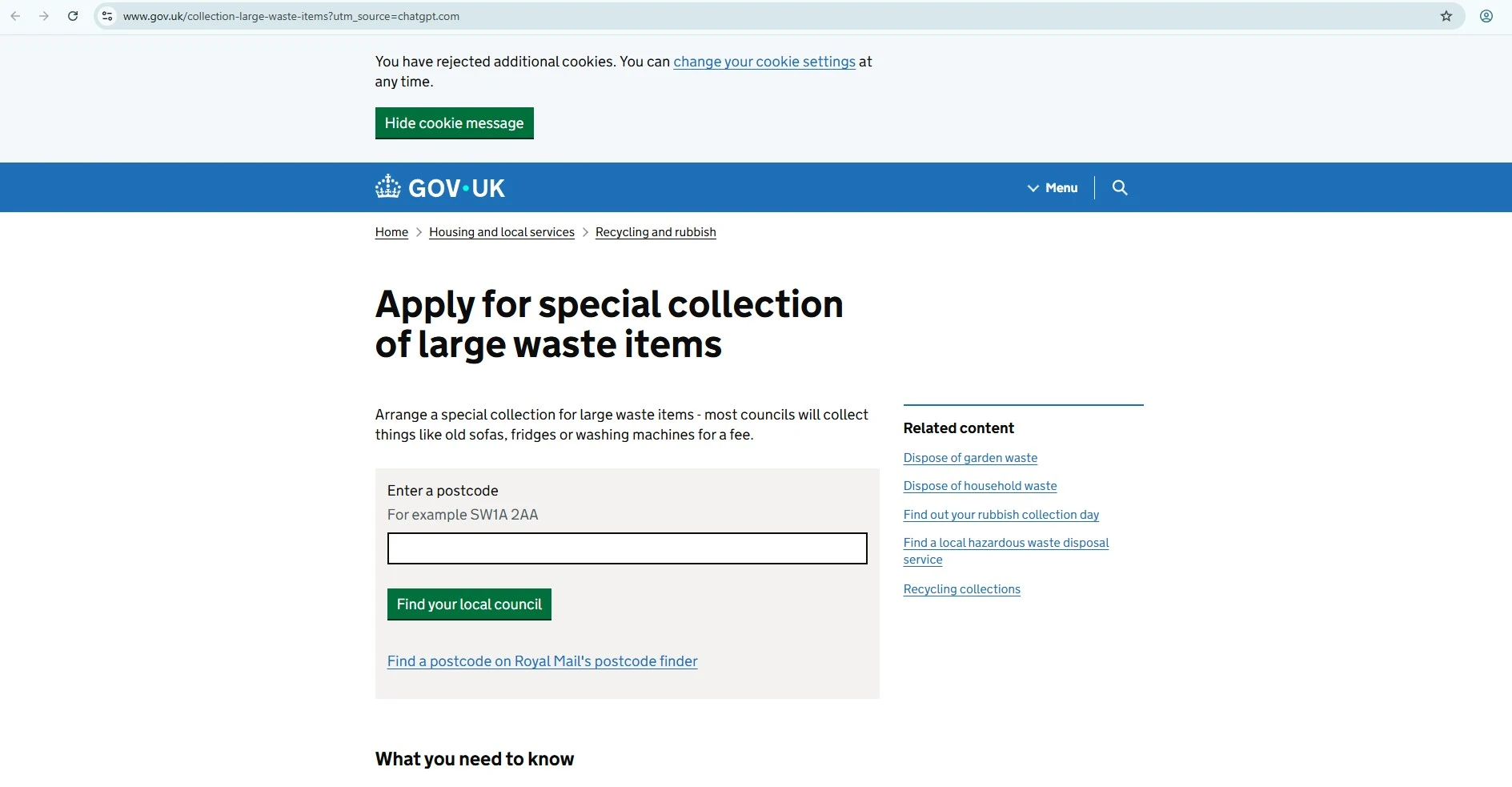
Official route helper
Book council bulky waste in the right order
Do not start by paying. Start by checking whether the item is reusable, accepted, correctly counted and safe to put out.
Check reuse before disposal
Clean and working items may be suitable for charity collection, local reuse, furniture reuse shops or retailer take-back. Reuse can be cheaper and faster than council pickup.
Find the correct council service
Enter the property postcode on the official finder, then use the council page for the final fee, item list and collection point.
Search every item separately
A bed base, mattress and headboard can count separately. A three-seat sofa may count differently from an armchair. Electrical and upholstered items may use a different stream.
Check access before choosing a date
If you live in a flat, above shops, behind a locked gate or on an estate, confirm the exact set-out point before booking.
Save proof before closing the page
Keep the payment receipt, reference number, confirmed items, collection date, set-out time, cancellation rule and missed-collection contact route.
Bulky-waste fees: why there is no national price
Live council pages show very different fee structures. Use these examples to understand the pattern, then confirm the current price on your own council page before payment.
| Example council pattern | What the live page shows | User-help lesson |
|---|---|---|
| GOV.UK national finder | Most councils collect sofas, fridges or washing machines for a fee, but you must enter a postcode. | GOV.UK is a route to the council, not a national price list. |
| Westminster example | A listed fee covered up to six items, with extra-item pricing. | Flat-fee collections can be good value only if all items are accepted. |
| Ashfield example | One item, up to three items, and extra items up to a maximum limit had different prices. | Adding one more item can change the fee band. |
| Bedford example | Different price bands were listed for up to five items and six to twelve items. | Item count matters as much as item type. |
| Kingston example | The page warned crews collect only items listed in the booking summary and gave collection-day set-out rules. | Wrong or extra items may be left behind. |
| Greater Cambridge example | The page separated bulky, hazardous and electrical routes and advised reuse before collection. | A fridge, sofa and carpet may not all follow the same route. |
Estimate your council booking fee
Enter the fee shown on your own council page. This tool does not use a national price because no national bulky-waste fee exists.
Check whether your bulky item is likely to be collected
This gives the likely route. The council’s item list is final, because local vehicles, contracts, crews and waste treatment rules differ.
Items councils commonly collect
These are common examples from council bulky-waste services. Always check the exact wording on your local page before paying.
Beds and bedroom furniture
Mattresses, bed frames, bed bases, headboards, wardrobes, bedside cabinets, drawers and dressing tables.
Living-room furniture
Sofas, armchairs, sofa beds, tables, dining chairs, desks, bookcases, cabinets and shelving.
Large appliances
Fridges, freezers, cookers, washing machines, tumble dryers and dishwashers, subject to electrical rules.
Electrical equipment
TVs, monitors, computers, microwaves, vacuums and small domestic appliances where your council accepts them.
Household and baby items
Bicycles, pushchairs, cots, high chairs, suitcases, ironing boards and exercise equipment.
Garden items
Garden furniture, barbecues, lawnmowers, rotary washing lines and dismantled play equipment, where accepted.
Items that often cause refused bulky-waste bookings
These items may need a recycling centre, hazardous-waste route, retailer take-back, commercial service or specialist disposal.
| Item or waste type | Why it may be refused | Better next step |
|---|---|---|
| Business or landlord clearance waste | Household bulky services normally exclude commercial activity. | Use a licensed commercial waste provider. |
| Rubble, soil, concrete, plasterboard | Heavy material exceeds normal collection vehicle and lifting rules. | Use an authorised recycling centre, skip or construction-waste route. |
| Asbestos, chemicals, fuel | Hazardous waste needs specialist handling. | Use your council’s hazardous-waste instructions. |
| Gas cylinders | Fire and pressure risks apply. | Return to supplier or use approved cylinder route. |
| Tyres and vehicle parts | Automotive waste is often excluded. | Use a tyre dealer, garage or authorised vehicle-waste route. |
| Loose black bags | Bulky collection is not an overflow-bin service. | Use normal household waste or recycling-centre arrangements. |
Sofas, armchairs and POPs: what the official guidance means for households
Upholstered domestic seating may contain persistent organic pollutants, called POPs. This is why many councils now ask residents to book or present upholstered seating separately.
Items likely to be treated as POPs seating
Sofas, sofa beds, armchairs, recliners, upholstered dining chairs, office chairs, stools, footstools, futons, bean bags, floor cushions and sofa cushions.
Items usually outside this seating rule
Non-upholstered wooden chairs, deckchairs, mattresses, beds, curtains and blinds are not covered as domestic seating by this guidance, though local disposal rules still apply.
Do not cut it open
Keep upholstered seating whole. Do not remove foam, rip cushions, cut fabric or mix torn foam with other bulky waste.
Keep it separate
Do not put rubble, bags, paint, electricals or mattresses on top of sofas or armchairs. Councils may collect upholstered items on a separate day or vehicle.
Duty of Care PDF: what to do before using a private collector
The official Duty of Care code says domestic occupiers should take reasonable measures to transfer household waste only to an authorised person. This matters if a “man and van” or house-clearance service offers to remove your bulky items.
Ask for the business name and registration number
In England, upper-tier waste carrier registration usually starts with CBDU followed by numbers. In Scotland, registered carriers must provide their registration number and expiry date.
Check the register before collection
Use the Environment Agency register in England, Natural Resources Wales in Wales, SEPA in Scotland, or DAERA/NIEA routes in Northern Ireland.
Ask where the waste will go
A legitimate collector should be able to explain the legal site or transfer station used. Very cheap cash-only offers with no paperwork are risky.
Keep evidence
Keep the receipt, registration number, business name, vehicle registration, date, item list and messages. If the items are later fly-tipped, these records help show you made reasonable checks.
Collection-day checklist: stop a failed pickup
A paid booking can still fail if items are late, hidden, unsafe, extra, wet, locked away or placed in the wrong location.
- Put out only the items listed in the booking confirmation.
- Use the exact set-out point: boundary, kerbside, bin store or council-named location.
- Check whether the council allows items out the night before or only on collection morning.
- Keep items visible, empty and safe to lift.
- Tape glass panels or sharp edges only where your council tells you to make them safe.
- Keep access clear: no locked gates, parked cars, loose dogs or blocked estate roads.
- Do not block pavements, fire exits, communal halls, stairs or bin access.
- Keep the booking reference and payment proof until the collection is complete.
Save your bulky-waste booking details
Use this browser-only note to keep your collection details together. It does not send information to WasteCollection.org.
Flats, tenants, landlords and shared buildings
Bulky collections fail more often at flats because crews need a clear, safe and agreed collection point.
Flats with bin stores
Some councils ask for items beside the bin store, not inside it. Others use the normal communal collection point or a vehicle-access area.
Upper-floor flats
Most crews do not enter homes or carry furniture downstairs. Arrange safe movement to the outside point before collection day.
Tenants moving out
Book early. Collection slots may not match tenancy-end dates, and abandoned furniture can affect deposits or trigger clearance charges.
Landlords and HMOs
Waste from property clearance or business activity may be commercial waste. Check the council terms before using a household bulky booking.
Free or cheaper routes to check before paying
The cheapest legal route depends on condition, urgency, access and whether the item can be reused.
| Route | Best when | Check first |
|---|---|---|
| Charity furniture collection | Furniture is clean, safe, saleable and has fire labels where required. | Charities can refuse stained, ripped or unsaleable items. |
| Retailer take-back | You are buying a replacement appliance or mattress. | Book removal before delivery and check disconnection rules. |
| Household recycling centre | You can transport the item safely and the site accepts it. | Booking, van permits, residency proof and POPs/DIY restrictions. |
| Council concession | Your council offers free or discounted bulky collections. | Benefit rules, annual limits, item caps and proof needed. |
Private waste collector safety check
Use this when council collection is too slow, the item is not accepted, or you need house-clearance help.
- Ask for the registered business name.
- Ask for the waste carrier registration number.
- Check the number on the correct official register.
- Ask where the waste will be taken.
- Get a receipt showing business details and what was collected.
- Keep photos or messages if the collection was arranged online.
- Avoid no-name, cash-only, no-receipt offers.
Official links used for final checks
Use these only after you understand which task you are doing: council collection, reuse, POPs seating, private collector checks or household-waste legal duties.
Official postcode route for England and Wales large-item collections.
Official Scotland route to local bulky uplift services.
Northern Ireland guidance for bulky household items.
Official rules explaining separate handling for sofas and padded seating.
Household duty to use authorised waste collectors.
Official code of practice for authorised waste transfer checks.
Bulky waste collection FAQs
How do I book bulky waste collection near me?
Is bulky waste collection free?
How much does bulky waste collection cost?
Will the council collect my sofa?
Can I book a mattress collection?
Will the council collect a fridge or freezer?
Can I leave bulky items on the pavement before collection?
Why was my bulky waste not collected?
Can landlords use household bulky collection?
How do I check a private bulky waste collector?
Information checked and update note
Information was refreshed on 3 July 2026 using official UK guidance, council bulky-waste examples and public-register guidance. Council fees, accepted items, collection slots, concessions, POPs handling and private-waste rules can change, so use the official links above for final booking decisions.